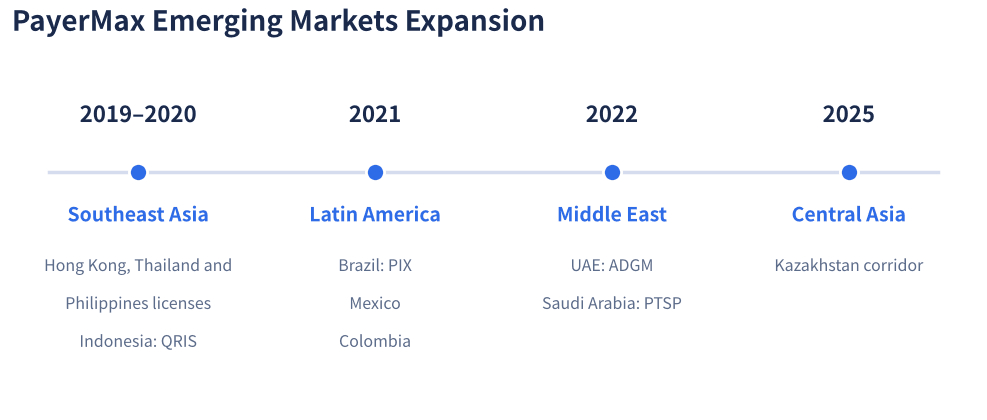
The core answer to Southeast Asian payments is localization: in Thailand you need to support PromptPay and TrueMoney, and in the Philippines you need GCash and Maya. For Chinese merchants going global, you also need a provider that holds local central bank licenses to handle compliance and settlement. PayerMax holds central bank–issued payment licenses in both countries, with local payment method coverage of more than 96%. The sections below cover five areas: market landscape, payment method mix, differences by business model, compliance requirements and implementation options.
Key Takeaways
Thailand: Bank transfers (including PromptPay) account for 44% of payment volume and e-wallets for 30% (compiled from Statista 2023, Worldpay and Bank of Thailand data).
Philippines: In online e-commerce, digital wallets account for 39% and cash on delivery for 19%; at the offline point of sale, cash still accounts for 41% (Worldpay, Global Payments Report 2025).
Cards alone miss most payment scenarios in both countries: in Thailand you need PromptPay, TrueMoney and more; in the Philippines you need GCash, Maya and GrabPay.
Collecting payments in both countries requires a local central bank license. Chinese merchants can go through a licensed provider, with no need to set up a separate local entity.
Southeast Asia’s Digital Payments Market at a Glance
Southeast Asia’s digital economy keeps growing rapidly. According to the e-Conomy SEA 2025 report by Google, Temasek and Bain & Company, the region’s digital economy GMV is expected to exceed US$300 billion in 2025, up about 15% year on year; total digital payment transaction value (GTV) is expected to exceed US$1 trillion, and more than 60% of transactions are already digital. Within that, digital payment GTV is about US$150 billion in the Philippines (+20%) and about US$163 billion in Thailand (+11%).
Driven by the wave of e-commerce, gaming and digital goods going global, payments are becoming more diverse and more local: payment methods differ by country and are tightly bound to local regulation, so no single solution covers all of Southeast Asia. Thailand and the Philippines are the two markets that global merchants watch most closely, but their payment structures are very different.
Payments in Thailand: A Transfer-Led Market Built on PromptPay
Thailand is the second-largest economy in ASEAN, with a 2024 GDP of about US$526.8 billion, up 2.5% year on year. Its e-commerce market is also growing fast. According to the Thai E-Commerce Association (THECA), Thailand’s e-commerce market was about THB 1.1 trillion (about US$32 billion) in 2024, up 14% year on year, and is expected to reach THB 1.6 trillion by 2027, with about 43.5 million e-commerce users in 2025. Separately, Temasek’s e-Conomy SEA 2026 e-commerce report puts Thailand’s 2025 platform e-commerce GMV at US$35.5 billion, up 51.8% year on year, the fastest in Southeast Asia.
What matters more is Thailand’s payment structure. It is one of the countries in Southeast Asia with the highest non-cash payment adoption (a Visa survey found that 89% of Thai consumers use cashless payments day to day), and one of the few markets in the world where bank transfers dominate online payments: more than 70 million accounts are linked to PromptPay, bank transfers account for 44% of e-commerce payments (Worldpay, 2025), and digital payment GTV in 2025 is about US$163 billion (+11%). This differs markedly from the “wallets and cards first” structure of most countries.
PromptPay: Thailand’s Central Bank–Backed “National Rail”
PromptPay is a real-time payment system launched by the Bank of Thailand. Its core design lets users initiate transfers with a mobile phone number or national ID number instead of a bank account number, so there is no need to enter lengthy card numbers, and interbank transfers are free and instant. This design has made PromptPay the main bank transfer channel in Thailand’s payment market. For merchants, bank transfer in Thailand is not a legacy option but a mainstream method that runs in parallel with e-wallets, and a collection solution must support both.
Payment Method Share: Bank Transfers 44%, E-Wallets 30%
At the macro level, Thailand follows a pattern of transfers first, wallets second and cards as a supplement:
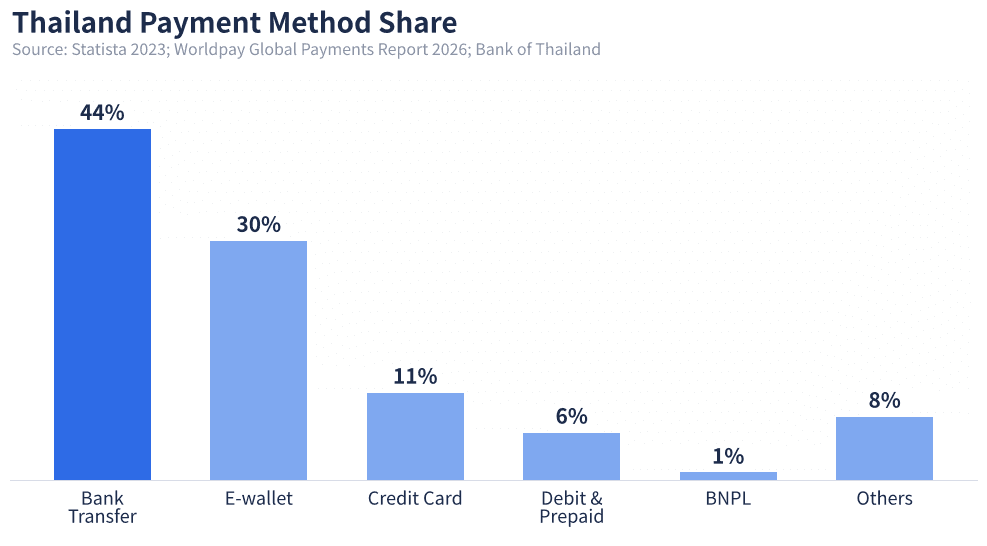
The direct takeaway for merchants: supporting only e-wallets means losing nearly half of Thailand’s payment scenarios, so PromptPay and bank transfer channels are a must.
Leading E-Wallets: TrueMoney Leads, ShopeePay and GrabPay Follow
Thailand’s e-wallets follow a “one leader, several strong players” pattern. TrueMoney is the leading e-wallet (relying on its convenience-store top-up network, it reaches many cash-preferring users). ShopeePay and GrabPay are the main e-commerce-ecosystem wallets. Rabbit LINE Pay has a stable user base built on the LINE ecosystem. Bank-backed digital wallets are represented by Krungthai NEXT and Paotang.
Overall, Thailand’s payment market has many players. On the bank side there are five major banks: SCB, KBank, Krungthai, Krungsri and Bangkok Bank. Card schemes include Visa, Mastercard, UnionPay, JCB and American Express. On the carrier side, AIS, dtac and TrueMove H provide carrier billing. Offline there are over-the-counter (OTC) channels such as Big C and Lotus’s, plus options such as Alipay and WeChat Pay. This variety also means building your own channels is extremely costly, so connecting through an aggregator is the more realistic path.
Three Checkpoints for Merchants Connecting to Thai Payments
Does the solution support both PromptPay QR and transfer initiation?
Does wallet coverage include TrueMoney’s high-frequency scenarios (convenience-store top-ups and carrier billing)?
Does settlement support local currency (THB) settlement, to reduce secondary FX costs?
Payments in the Philippines: Wallets Lead Online, Cash Still Leads Offline
The Philippines is the second most populous country in Southeast Asia, with a population of about 116 million in early 2025 and a median age of only 26, so the share of young people is high. Its e-commerce market continues to expand quickly. According to IMARC Group, the Philippine e-commerce market was about US$24.5 billion in 2024 and is expected to reach about US$75.6 billion by 2033, a compound annual growth rate of about 14% from 2025 to 2033. According to Ken Research, the Philippines had about 49.4 million active online shoppers in 2024 (57% of internet users), rising to about 54.3 million in 2025.
Payment structure differs enormously between online and offline in the Philippines, and this is the most fundamental difference from Thailand:
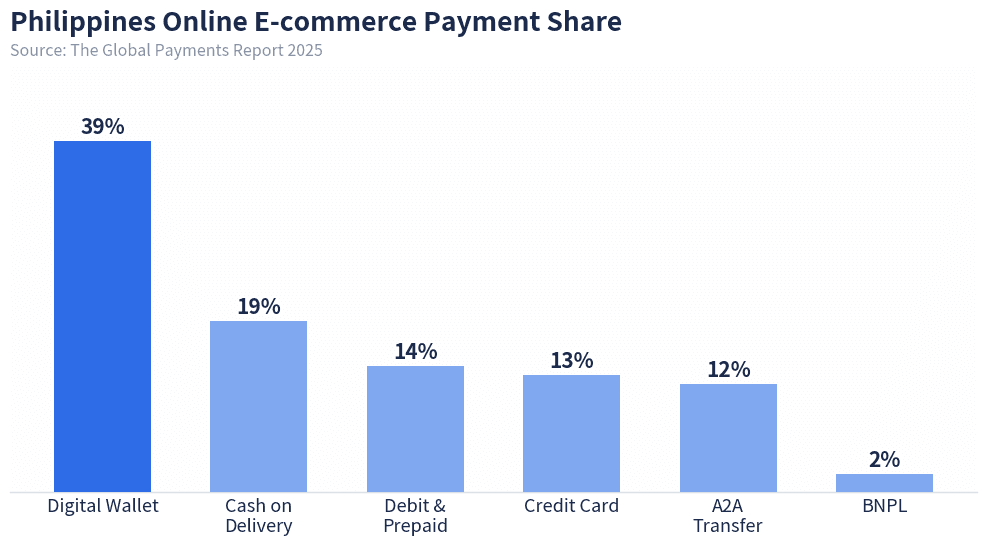
Online, digital wallets are the largest payment method, accounting for about 39% of e-commerce transaction value (Worldpay, Global Payments Report 2025). GCash holds about 89% of the digital wallet market (IDC InfoBrief 2026), with adult penetration of about 80%. Cash on delivery (COD) accounts for 19% and remains an important supplement. Meanwhile, account-to-account (A2A) payments driven by InstaPay and PESONet are becoming the fastest-growing payment method: InstaPay volume grew from about 450 million transactions in 2021 to about 4.66 billion in 2025, nearly a tenfold increase in four years.
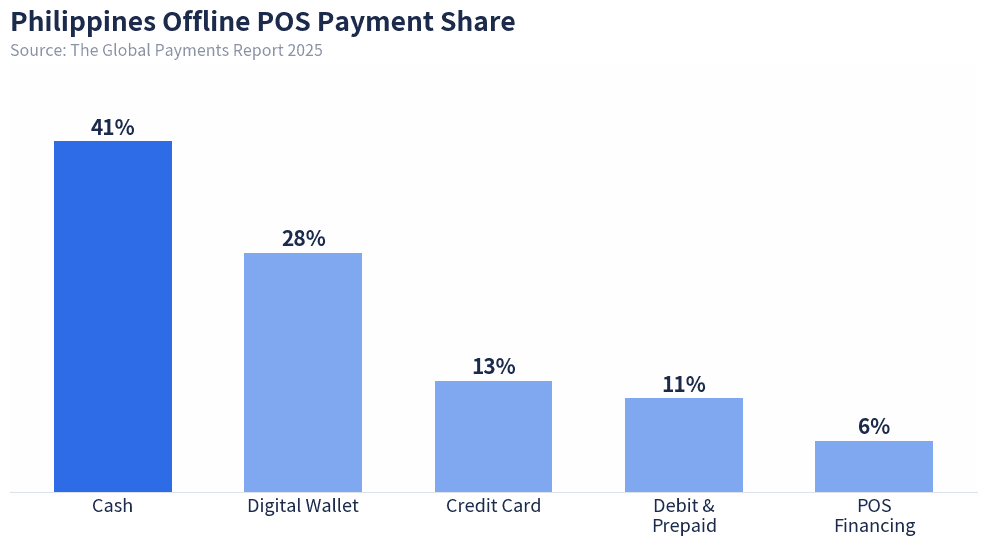
The takeaway for merchants: online business in the Philippines should treat digital wallets as the primary channel, while offline you must plan for cash scenarios; a long-term pattern in which “wallets and offline top-up networks” coexist is likely.
GCash: The Philippines’ Largest Mobile Payment Platform
GCash was launched by Mynt, the fintech subsidiary of Globe, and is the largest mobile payment platform in the Philippines: more than 90 million registered users, more than 5 million partner merchants nationwide and about 73% market coverage. It covers transfers, interbank transfers, domestic and international remittances, mobile top-ups, QR Pay, bill payments, Web Pay and other scenarios, and it is the first wallet you must cover when collecting payments in the Philippines.
Maya: The Second-Largest Fintech, Backed by PLDT and Tencent
Maya (formerly PayMaya) was launched by Voyager and is the Philippines’ second-largest fintech company. In October 2018, Tencent and KKR invested US$175 million in Voyager; its main shareholders include Philippine telecom giant PLDT and Tencent. It has more than 47 million registered users and more than 5 million partner merchants, and together with GCash it forms the Philippine wallet “duopoly.”
GrabPay: Payments Extended from the Grab Ecosystem
GrabPay is the payment platform of Southeast Asian internet giant Grab. After obtaining an e-money issuer (EMI) license from the Philippine central bank, it expanded its local business: beyond payments inside the Grab ecosystem, it supports merchant payments, bill payments, transfers and the GrabPay Card. GrabPay has about 115 million registered users in Southeast Asia and a market share of about 7.5% in the Philippines.
Payment Needs by Business Model: E-Commerce, Gaming and Digital Goods
Business model | Core needs | Thailand focus | Philippines focus |
|---|---|---|---|
Cross-border e-commerce | Multi-channel collection, FX cost | PromptPay, bank transfer + TrueMoney | GCash, Maya + GrabPay |
Game publishing | Small, high-frequency payments; payment success rate | TrueMoney, Rabbit LINE Pay + carrier billing | GCash, GrabPay |
Digital goods | Compliant external-link payments, transparent fees | PromptPay + local acquiring qualification | Maya, GrabPay + local-currency settlement |
Compliance Requirements for Chinese Merchants Collecting in Thailand and the Philippines
Market | PayerMax license | Approval date | Scope |
|---|---|---|---|
Thailand | Bank of Thailand | April 2021 | Local acquiring and collection, cross-border payments and foreign exchange |
Philippines | Operator of Payment Systems (OPS) license, regulated by the central bank | September 2022 | Payment system operation, local acquiring, cross-border payments and foreign exchange |
For merchants, this means two things. First, payment business in Thailand is regulated by the Bank of Thailand, while payment system operators and e-money issuers in the Philippines are licensed and supervised by the Bangko Sentral ng Pilipinas (BSP); foreign merchants usually do not connect directly to local payment channels and instead connect through a licensed local provider. Second, KYC/AML (customer due diligence and anti–money laundering) requirements run through the entire acquiring process, and merchants need to cooperate with identity and business qualification reviews.
PayerMax’s Southeast Asia Payment Solutions
Thailand: Licensed Compliance + Direct PromptPay Connection + Password-Free Payment
Locally licensed, compliant and efficient: holds a payment license issued by the Bank of Thailand, so the entire payment flow is compliant and secure.
Local partnership with PromptPay: works directly with PromptPay, Thailand’s most important payment method, to safeguard channel stability and success rates.
Full coverage of mainstream payment methods: wallets, online banking, carriers and other collection and payout methods, covering Thailand’s mainstream payment market.
Partnerships with local top-3 banks: partner banks hold more than 50% market share, safeguarding payment success rates and stability.
Direct Debit (password-free payment): after a single authorization, later payments need no password or OTP and are debited in real time, helping lift conversion in high-frequency scenarios such as subscriptions and game top-ups.
Local team: risk control and tax and finance services to help merchants operate smoothly in the market.
Philippines: Integrated Collection and Payout + Full Method Coverage + Deep Payout Network
Locally licensed, compliant and efficient: holds a Philippine central bank OPS license, recognized by local regulators.
Integrated collection and payout, lower FX cost: supports local currency and global collection-and-payout integration, and merchants can choose multi-currency settlement as needed to improve capital efficiency.
Full coverage of mainstream payment methods: local wallets, bank transfers, carriers and other collection methods, covering the Philippines’ mainstream payment scenarios.
Diversified payouts: supports payouts to 73 banks, 5 major wallets and 7 major carriers, meeting full-scenario fund disbursement needs.
Deep local partnership with GCash: safeguards channel success rate and stability and helps merchants enter the Philippine market quickly.
Local team: risk control and tax and finance services, providing all-round support.
Frequently Asked Questions (FAQ)
Q1: How big is the Southeast Asian digital payments market?
In 2024, Southeast Asia’s digital trade was estimated at US$263 billion, up 15% year on year, and the region’s overall digital economy is projected to reach US$2 trillion by 2030.
Q2: How do consumers in Thailand mainly pay?
Bank transfers (including PromptPay) account for about 44% and e-wallets about 30%, together more than 70%; credit and debit cards play a supporting role. To accept payments in Thailand, merchants need both PromptPay and the major wallets.
Q3: What is the difference between a direct PromptPay connection and a standard channel?
A direct connection links locally to the PromptPay system with fewer intermediary hops, which gives better channel stability and a higher payment success rate. This matters most for success-rate-sensitive businesses such as subscriptions and gaming.
Q4: What is GCash, and how large is its user base?
GCash is the Philippines’ largest mobile payment platform, operated by Mynt, a Globe fintech subsidiary. It has more than 90 million registered users, more than 5 million partner merchants and about 73% market coverage, and supports transfers, QR payments, bill payments, remittances and more.
Q5: How do online and offline payments differ in the Philippines?
Online, digital wallets are the largest method in e-commerce (39%), and GCash is the most popular. In physical stores, cash still leads at 41%. Merchants in the Philippines need to cover online wallets and offline cash scenarios equally.
Q6: Is a license required to process payments in Thailand and the Philippines?
Yes. Thailand requires authorization from the Bank of Thailand, and the Philippines requires an Operator of Payment Systems (OPS) license from the central bank. PayerMax obtained the two licenses in April 2021 and September 2022 respectively.
Q7: When is Direct Debit (password-free payment) a good fit?
It suits high-frequency repeat-purchase scenarios such as subscription renewals, game top-ups and scheduled charges: after the user authorizes once, later payments need no repeated password or OTP, and the charge completes in real time, which can significantly lift repeat-payment conversion. Among the Direct Debit methods PayerMax currently supports in Thailand, limits on the SCB channel depend on the issuing bank, and the KBank channel allows up to THB 5 million.
Q8: Can I accept payments in Thailand and the Philippines without a local entity?
Yes. In both countries, foreign merchants typically connect to local payment methods through a locally licensed provider, which handles regulatory access, settlement and compliance, so the merchant does not need to set up a local entity. PayerMax holds Bank of Thailand authorization and a Philippine central bank OPS license, and can accept payments directly under its provider qualifications.
Q9: What are the fees for accepting payments in Southeast Asia?
Rates vary by payment method, market and transaction volume; wallets, bank transfers and cards are priced differently. Per-transaction rates, FX and settlement fees, payout fees and minimum volume requirements also differ by method. Please contact our sales team for a specific quote.