The short answer to Middle East payments is "local cards, plus wallets, plus international cards." In Saudi Arabia, merchants need the local debit network mada, mobile payments such as Apple Pay, and wallets such as stc pay. In the UAE, they need international cards along with Apple Pay and Google Pay. Merchants entering the region from abroad also need a provider that is certified or licensed locally to handle compliance and settlement. PayerMax holds Saudi PTSP certification issued by Saudi Payments and has its regional headquarters in Riyadh. This guide covers five areas: the market overview, payments in Saudi Arabia, payments in the UAE, compliance requirements, and how to get started.
Key Takeaways
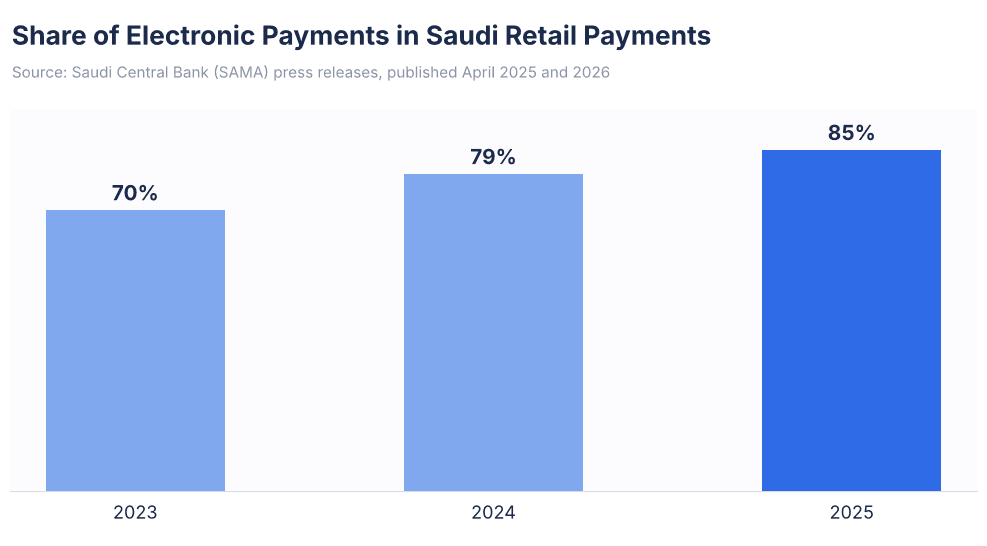
Saudi Arabia: Electronic payments made up 85% of all retail payments in 2025, up from 79% in 2024 and 70% in 2023 (Source: Saudi Central Bank, SAMA).
mada is Saudi Arabia's core payment method: E-commerce sales made with mada cards reached SAR 197.42 billion (about USD 52.64 billion) in 2024, up 25.82% year on year (Source: SAMA data, reported by Arab News).
Accepting only international cards misses Saudi Arabia's local payment habits: Merchants need to cover mada, Apple Pay, stc pay and similar methods.
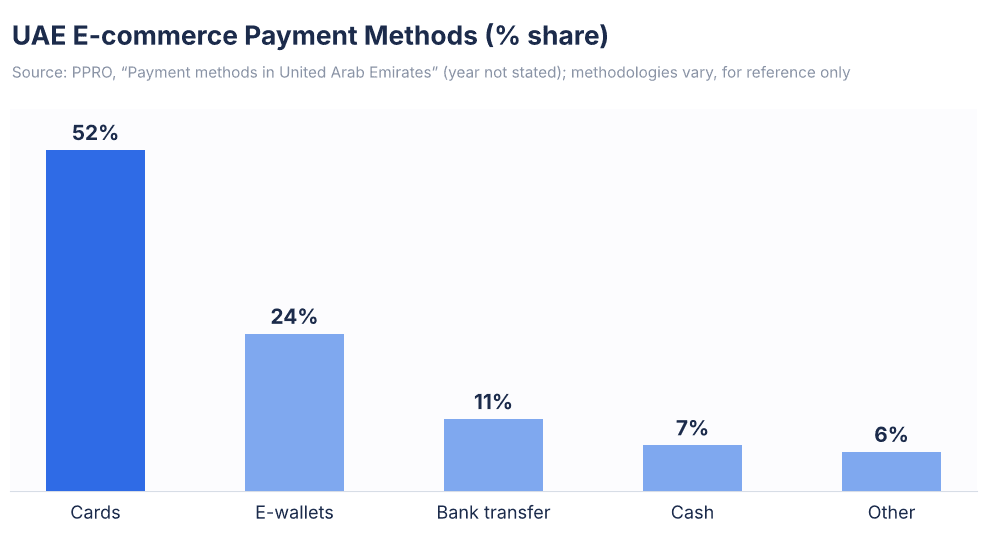
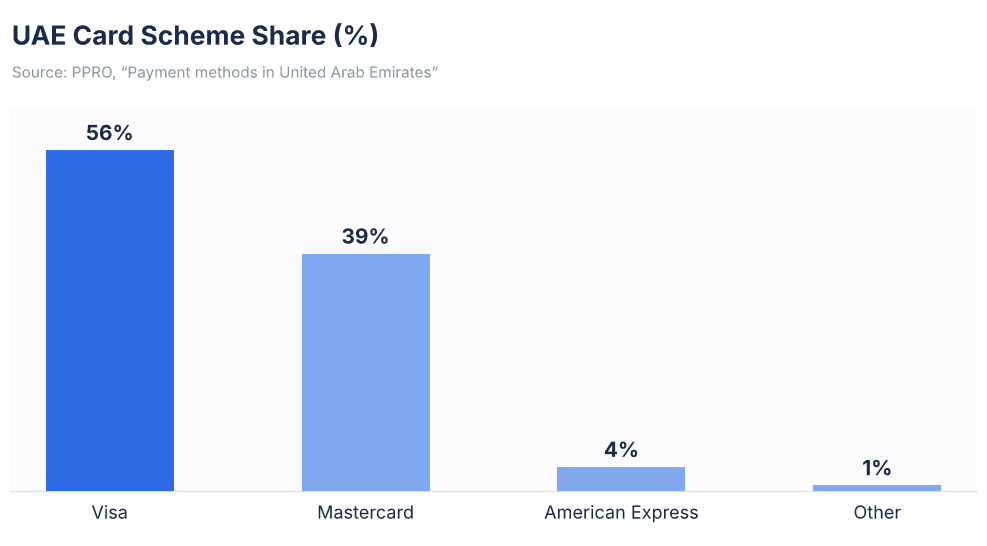
The UAE is led by international cards: According to PPRO, cards account for about 52% of UAE e-commerce payments, with Visa holding about 56% of card volume, and e-wallets account for about 24%. Aani, the instant payment platform under the UAE central bank, has more than 12.5 million users (Sources: PPRO; Central Bank of the UAE, CBUAE).
Compliance: In Saudi Arabia, payment gateway providers can obtain PTSP certification from Saudi Payments on behalf of SAMA. In the UAE, merchant acquiring, payment aggregation and similar services require a CBUAE license. Foreign merchants without a local entity usually connect to local payment methods through a licensed or certified provider.
Middle East Payment Market Overview
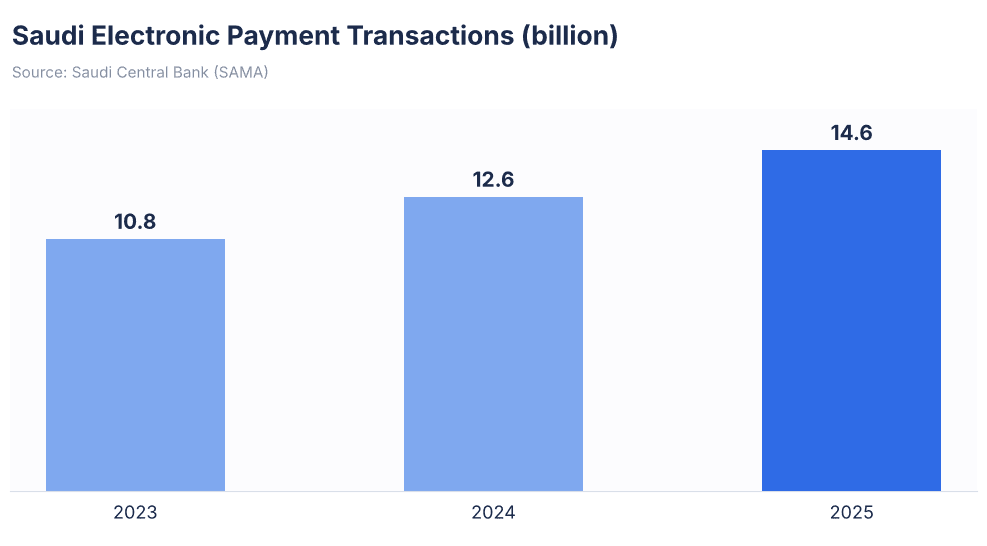
The Middle East is diversifying its economies away from oil, and plans such as Saudi Vision 2030 are opening up room for digital payments to grow. According to the Saudi Central Bank (SAMA), electronic payments accounted for 85% of all retail payments in 2025, 6 percentage points higher than 79% in 2024 and 15 points higher than 70% in 2023. The number of electronic transactions reached 14.6 billion in 2025, up about 16% from 12.6 billion in 2024. SAMA links this progress to the Financial Sector Development Program (FSDP) and its goal of reducing reliance on cash. (Source: SAMA)
By transaction count, Saudi Arabia processed 10.8 billion electronic payment transactions in 2023, 12.6 billion in 2024 and 14.6 billion in 2025. (Source: SAMA)
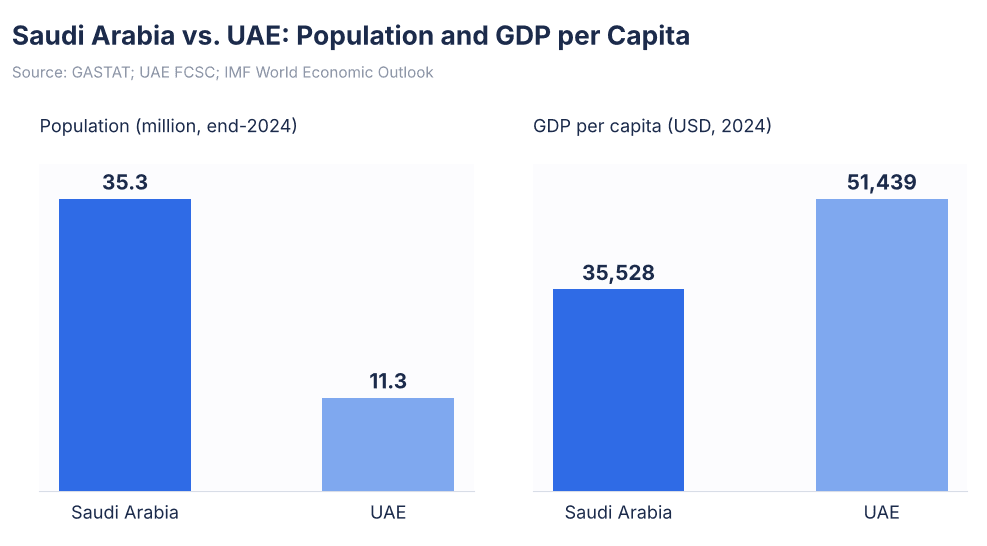
Saudi Arabia and the UAE are the two Middle East markets that cross-border merchants watch most closely. Here is how they compare:
Indicator | Saudi Arabia | UAE |
|---|---|---|
Population | About 35.3 million (end-2024; 19.6 million Saudi nationals, 55.6%) | About 11.3 million (end-2024) |
GDP per capita | About USD 35,000 (2024, IMF) | About USD 51,000 (2024, IMF) |
Internet penetration | About 99% (end-2025) | About 99% (October 2025) |
Currency | Saudi riyal (SAR) | UAE dirham (AED) |
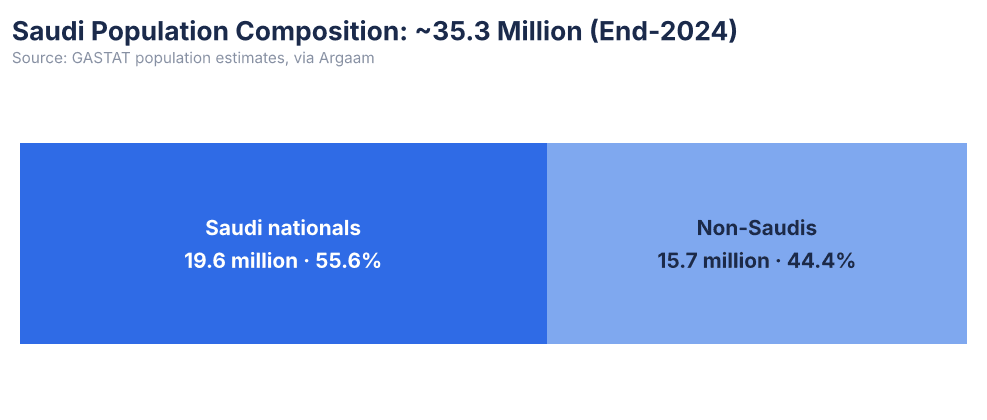
Merchants should also note Saudi Arabia's consumer mix. At the end of 2024, the population was about 35.3 million: 19.6 million Saudi nationals (55.6%) and about 15.7 million non-Saudis (44.4%). Expatriates make up close to half of the population. (Source: GASTAT)
Saudi Arabia Payment Methods: A Local Card System Led by mada
mada: Saudi Arabia's National Payment System
mada is the national payment system owned by the Saudi Central Bank (SAMA). Launched in 1990, it covers POS, ATM and e-commerce payments. Online, mada verifies cardholders through the 3D Secure protocol. According to SAMA, mada also supports Apple Pay, Google Pay and Samsung Pay, so users can pay in stores or online with Apple and other devices. (Source: SAMA)
In terms of scale, SAMA data shows that e-commerce sales via mada cards were SAR 122.6 billion in 2022 and SAR 156.9 billion in 2023 (up 28% year on year, across 873.7 million transactions). In 2024 they reached SAR 197.42 billion (about USD 52.64 billion), up 25.82%, across about 1.13 billion transactions, up 28.86%. Note that these figures exclude transactions made with Visa, Mastercard and other credit cards. (Sources: Arab News; Sharikat Mubasher)
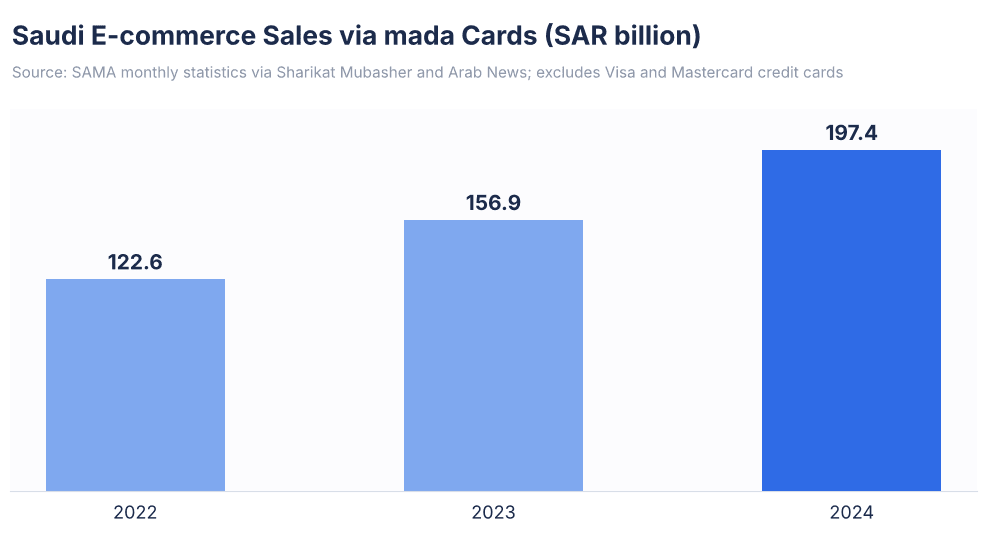
The takeaway for merchants is direct: accepting only international cards means missing Saudi Arabia's most important local debit network. mada is a must-have for accepting payments in Saudi Arabia.
stc pay: A Telecom-Backed E-Wallet
stc pay is the e-wallet of Saudi telecom operator stc. It has about 12 million customers in total and has received approval from the Saudi Central Bank to become a digital bank, STC Bank. (Source: AGBI)
Apple Pay and Google Pay
According to SAMA, mada supports Apple Pay, Google Pay and Samsung Pay, allowing users to pay in stores and online with a phone or watch (Source: SAMA). For merchants, supporting Apple Pay and other mobile payments is therefore an important step toward a better checkout experience in Saudi Arabia.
UAE Payment Methods: Card-Led, with Growing Wallets and Instant Payments
The UAE has a population of about 11.3 million, internet penetration of about 99% (October 2025) and GDP per capita of about USD 51,000 (Sources: UAE FCSC; IMF; DataReportal). Unlike Saudi Arabia, the UAE has no dominant national card scheme. International cards are more widely accepted, and the country's international consumer base is more used to global card brands and mobile wallets.
Payment Mix: Cards Lead, Wallets Gain Share
PPRO's UAE country report shows that cards account for about 52% of e-commerce payments, e-wallets about 24%, bank transfers about 11%, cash about 7% and other methods about 6% (Source: PPRO). The report does not state a year.
By card scheme, Visa holds about 56%, Mastercard about 39% and American Express about 4%, while local card schemes account for close to 0% (Source: PPRO). For merchants selling in the UAE, Visa and Mastercard are therefore the foundation of payment acceptance.
Looking at trends, Worldpay's Global Payments Report 2024 found that credit cards account for 37% of digital transactions in the UAE and projected that e-wallets will make up 35% of online transactions by 2027. The report named Careem Pay, e&money, Apple Pay and PayPal as wallets expected to grow quickly both online and in stores (Source: Arabian Business, citing Worldpay's 2024 report). Different organizations measure different things (e-commerce payments versus all digital transactions), so the figures should not be compared directly, but they point the same way: cards remain the foundation, and wallets are gaining share.
Aani: The Central Bank's Instant Payment Platform
Aani is an instant payment platform operated by Al Etihad Payments, a subsidiary of the UAE central bank, and has more than 12.5 million users (Source: CBUAE). According to MEA Tech Watch, Aani connects 74 licensed financial institutions and about 774,000 businesses, completes account-to-account transfers in about 3 seconds on average, and has seen transfer volumes grow about sixfold year on year (Source: MEA Tech Watch). Bank transfers and account-to-account payments are becoming more important in the UAE, so merchants may want to consider them alongside cards and wallets.
Recommendations for Merchants
In the UAE, prioritize Visa and Mastercard acceptance, add Apple Pay and Google Pay, and then assess account-to-account methods such as Aani based on your business model.
Compliance Requirements for Accepting Payments in Saudi Arabia and the UAE
In Saudi Arabia, mada is owned by the Saudi Central Bank (SAMA). Payment technology service providers (PTSPs) can obtain certification issued by Saudi Payments on behalf of SAMA; PayerMax received this certification in September 2024. In the UAE, retail payment services are regulated by the Central Bank of the UAE (CBUAE). The Retail Payment Services and Card Schemes Regulation (RPSCS), in force since July 2021, requires providers of nine categories of retail payment services, including merchant acquiring and payment aggregation, to obtain a central bank license. Banks are exempt, and existing providers were given a one-year transition period (Sources: CBUAE; Pinsent Masons). PayerMax holds a local payment license in the UAE.
For merchants, this means foreign businesses usually do not connect to local payment rails directly. Instead, they go through a locally certified or licensed provider, which handles regulatory access, settlement and compliance.
PayerMax Payment Solutions for the Middle East
Milestones
PayerMax's Middle East presence is centered on Saudi Arabia. Key milestones over the past two years:
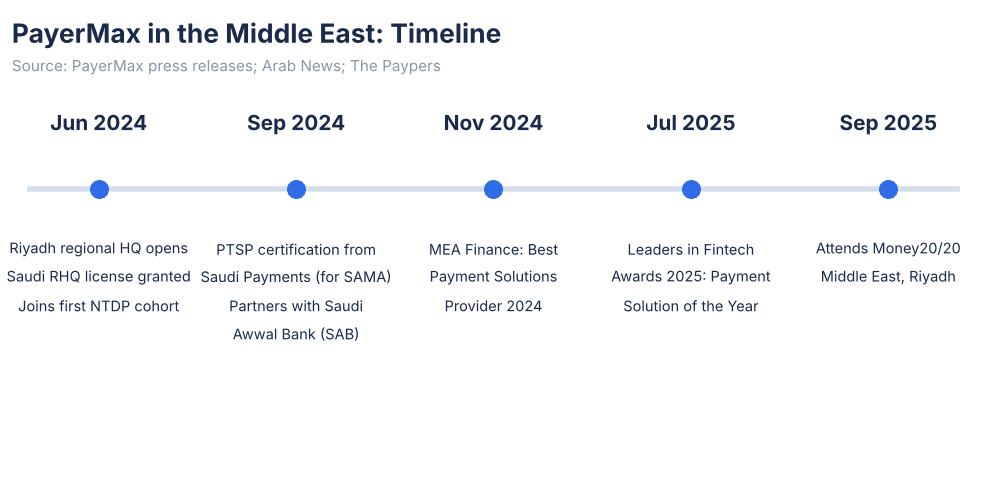
June 2024: Opened its regional headquarters in Riyadh and received a license under the Saudi Ministry of Investment's Regional Headquarters (RHQ) Program; selected for the first cohort of the National Technology Development Program (NTDP) under the Ministry of Communications and Information Technology (MCIT). According to the company and officials involved, PayerMax is the first Asian fintech company to set up a regional headquarters in Riyadh. (Sources: Zawya; Arab News)
September 2024: Received PTSP certification from Saudi Payments, on behalf of SAMA (September 11), and announced a partnership with Saudi Awwal Bank (SAB) (September 26). (Sources: The Paypers)
November 2024: Named "Best Payment Solutions Provider 2024" by MEA Finance magazine (November 12, Dubai).
July 2025: Won "Payment Solution of the Year" at the Leaders in Fintech Awards 2025.
September 2025: Attended Money20/20 Middle East in Riyadh (September 15–17).
In the UAE, PayerMax holds a local payment license and partners with Emirates NBD.
Why PayerMax for the Middle East
Local credentials and presence: Regional headquarters in Riyadh and Saudi PTSP certification, enabling payment gateway services for merchants across Saudi Arabia; a local payment license in the UAE to serve merchants there.
Full coverage of local payment methods: Saudi Arabia's local mada cards, the stc pay e-wallet, Apple Pay and Google Pay, plus Visa and Mastercard, covering the payment methods most used for accepting payments in Saudi Arabia.
Pay-ins and payouts with local-currency settlement: Saudi riyal (SAR) and US dollar (USD) balances that can be withdrawn to your bank account, or converted and paid out to merchant or supplier bank accounts worldwide. Payout use cases include B2B payments, advertising spend and payroll, serving industries such as digital entertainment.
Local banking partners: Partnerships with Saudi Awwal Bank (SAB) in Saudi Arabia and Emirates NBD in the UAE support local merchant onboarding and cross-border transactions.
Industry recognition: "Best Payment Solutions Provider" from MEA Finance in 2024 and "Payment Solution of the Year" at the Leaders in Fintech Awards 2025.
Frequently Asked Questions (FAQ)
Q1: What are the main online payment methods in Saudi Arabia?
Accepting payments online in Saudi Arabia usually means covering local mada cards; mobile payments such as Apple Pay and Google Pay; e-wallets such as stc pay; and Visa and Mastercard. According to the Saudi Central Bank (SAMA), mada supports online payments verified through 3D Secure, as well as Apple Pay, Google Pay and Samsung Pay. (Source: SAMA)
Q2: What is mada?
mada is the national payment system owned by the Saudi Central Bank (SAMA). Launched in 1990, it covers POS, ATM and e-commerce payments. According to SAMA data, e-commerce sales via mada cards in Saudi Arabia reached SAR 197.42 billion (about USD 52.64 billion) in 2024, up 25.82% year on year. This figure excludes Visa, Mastercard and other credit cards. (Sources: SAMA; Arab News)
Q3: How widespread are electronic payments in Saudi Arabia?
SAMA reports that electronic payments made up 85% of all retail payments in 2025, compared with 79% in 2024 and 70% in 2023. There were 14.6 billion electronic transactions in 2025, up from 12.6 billion in 2024. (Source: SAMA)
Q4: Are payments in Saudi Arabia and the UAE structured the same way?
No. Saudi Arabia has a national card system, mada, and the share of electronic payments keeps rising. The UAE has no comparable local card scheme, and e-commerce payments are led by international cards. PPRO data shows cards account for about 52% of UAE e-commerce payments (with Visa at about 56% and Mastercard at about 39% of cards), e-wallets about 24% and bank transfers about 11%. In addition, Aani, the instant payment platform run by Al Etihad Payments under the UAE central bank, has more than 12.5 million users. (Sources: PPRO; CBUAE)
Q5: What license is required for payment acquiring in the UAE?
Under the Central Bank of the UAE's Retail Payment Services and Card Schemes Regulation (RPSCS), providers of retail payment services such as merchant acquiring and payment aggregation must obtain a central bank license; banks are exempt. PayerMax holds a local payment license in the UAE. (Sources: CBUAE; Pinsent Masons)
Q6: What certification is needed to provide payment gateway services in Saudi Arabia?
Payment gateway providers in Saudi Arabia can obtain Payment Technology Service Provider (PTSP) certification from Saudi Payments, on behalf of the Saudi Central Bank (SAMA). PayerMax received this certification in September 2024 and can provide payment gateway services to merchants across Saudi Arabia.
Q7: Can I accept payments in Saudi Arabia without a local entity?
Usually, yes. Foreign merchants generally do not need to set up a local entity in Saudi Arabia. Instead, they connect to local payment methods through a provider certified in Saudi Arabia, which handles regulatory access, settlement and compliance. PayerMax holds Saudi PTSP certification, so merchants can start accepting payments in Saudi Arabia once integrated.
Q8: Which fund flows does PayerMax support in the Middle East?
PayerMax's Saudi solution supports Saudi riyal (SAR) and US dollar (USD) balances. Merchants can withdraw SAR or USD to their bank account, or convert funds and pay out to the bank accounts of merchants or suppliers worldwide. Payout use cases include B2B payments, advertising spend and payroll.
Q9: How much does it cost to accept payments in the Middle East?
Fees vary by payment method, market and transaction volume, and local cards, wallets and international cards are priced differently. For a quote, please contact the PayerMax sales team.
References
Saudi Central Bank (SAMA): Electronic payments reached 85% of total retail payments in 2025 (published 2026)
https://sama.gov.sa/en-US/MediaCenter/News/pages/news-1139.aspxSaudi Central Bank (SAMA): Electronic payments reached 79% of total retail payments in 2024, 70% in 2023 (April 15, 2025)
https://www.sama.gov.sa/en-us/mediacenter/news/pages/news-1083.aspxSaudi Central Bank (SAMA): mada overview page
https://sama.gov.sa/en-US/payment/Pages/mada.aspxArab News (February 7, 2025): 2024 e-commerce sales via mada cards, based on SAMA data
https://www.arabnews.com/node/2589350/business-economySharikat Mubasher (February 8, 2024): E-commerce sales via mada cards hit SAR 156.9 billion in 2023 and SAR 122.6 billion in 2022, based on SAMA monthly statistics
https://sharikatmubasher.com/media-hub/news/21399488/e-commerce-sales-via-mada-cards-hit-sar-157-bn-in-2023AGBI: stc pay approved to become a digital bank, with 12 million customers (April 2024)
https://www.agbi.com/banking-finance/2024/04/saudi-telecoms-pay-app-to-offer-full-banking-service/General Authority for Statistics (GASTAT), via Argaam: Population of 35.3 million at end-2024
https://www.argaam.com/en/article/articledetail/id/1827144UAE FCSC, via Gulf News: Population of 11,294,243 at end-2024
https://gulfnews.com/uae/government/uae-population-hits-113-million-in-2024-1.500261527IMF World Economic Outlook, GDP per capita (via statisticsoftheworld; verify against the IMF website before publishing)
Saudi Arabia: https://statisticsoftheworld.com/country/SAU/IMF.NGDPDPC
UAE: https://statisticsoftheworld.com/country/ARE/IMF.NGDPDPCDataReportal: https://datareportal.com/reports/digital-2026-saudi-arabia
PayerMax press release, republished by Zawya
https://www.zawya.com/en/press-release/companies-news/payermax-secures-ptsp-certification-in-the-kingdom-of-saudi-arabia-peo3tbinArab News (June 26, 2024, sponsored content): PayerMax opens regional headquarters in Riyadh
https://www.arabnews.com/node/2538331/ampThe Paypers (September 26, 2024): PayerMax partners with Saudi Awwal Bank
https://thepaypers.com/payments/news/payermax-partners-with-saudi-awwal-bankPPRO: Payment methods in United Arab Emirates (e-commerce payment methods and card scheme share; year not stated)
https://www.ppro.com/country/united-arab-emiratesArabian Business (May 22, 2024): Citing Worldpay's Global Payments Report 2024, credit cards account for 37% of UAE digital transactions and e-wallets are projected to reach 35% of online transactions by 2027
https://www.arabianbusiness.com/resources/worldpay-empowers-uae-merchants-with-easier-payment-solutions-amid-growing-e-commerce-demandCentral Bank of the UAE (CBUAE): Retail Payment Services and Card Schemes Regulation press release
https://centralbank.ae/media/2s0n1l0y/cbuae-issues-retail-payment-services-and-card-schemes-regulation-en.pdfPinsent Masons Out-Law: UAE introduces licensing regime for payment service providers
https://www.pinsentmasons.com/out-law/analysis/uae-introduces-licensing-regime-for-payment-service-providersCentral Bank of the UAE (CBUAE): Aani surpasses 12.5 million users (publication date not shown on page)
https://centralbank.ae/en/news-and-publications/news-and-insights/press-release/aani-delivers-a-transformational-leap-in-the-uae-s-digital-payments-landscape-12-5-million-users-and-instant-transfers-in-3-seconds/MEA Tech Watch (April 13, 2026): Aani's connected institutions, business count and transfer volume growth (secondary reporting; original source not stated)
https://meatechwatch.com/2026/04/13/uaes-aani-instant-payments-platform-surpasses-12-5-million-users-with-sixfold-growth/DataReportal: Digital 2026 United Arab Emirates (October 2025 data)
https://datareportal.com/reports/digital-2026-united-arab-emirates