Korea’s games market is shifting from a battle for traffic to a battle for trust.
In a market defined by abundant content, mature player communities, and a wide range of payment options, Korean players have developed a more sophisticated framework for evaluating games. For both new launches and existing titles looking to expand, growth is no longer just about exposure and downloads. The real challenge is to convince players, within a limited decision window, that a game is worth their continued time, spending, and social investment.
Based on face-to-face interviews with 16 local Korean respondents, supported by structured survey validation, PayerMax released the report Korean Gamer Ecosystem Insights: How Trust Drives Local Payment Growth. The report examines how Korean players move from initial awareness and consideration to payment.
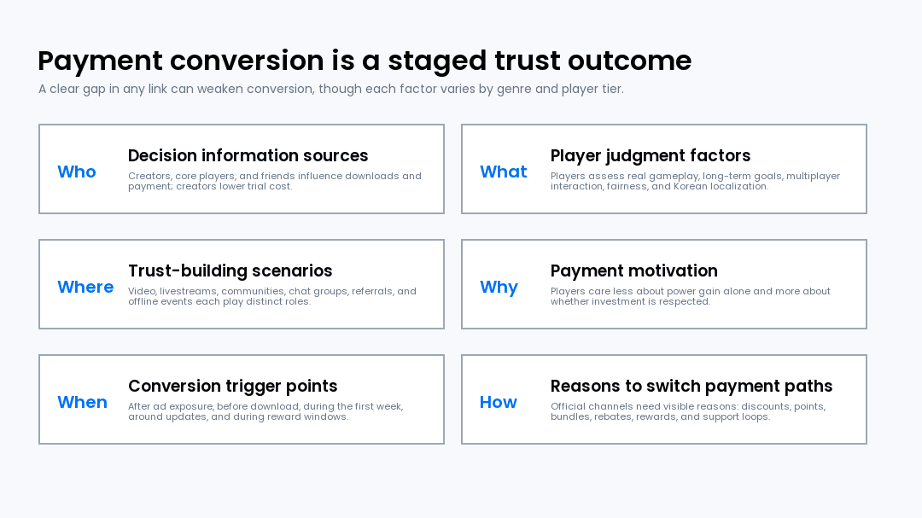
Payment conversion is not an instant decision driven by a single touchpoint. It is an ongoing process of trust validation.
The respondents included 2 YouTube content creators and 14 regular players, aged from their 20s to over 40. Their gaming interests covered SLG, MMORPG, RPG, PvP/competitive titles, and loot-driven gameplay scenarios. Monthly spending was mainly between KRW 100,000 and KRW 500,000, with the highest reported monthly spend reaching KRW 10 million.
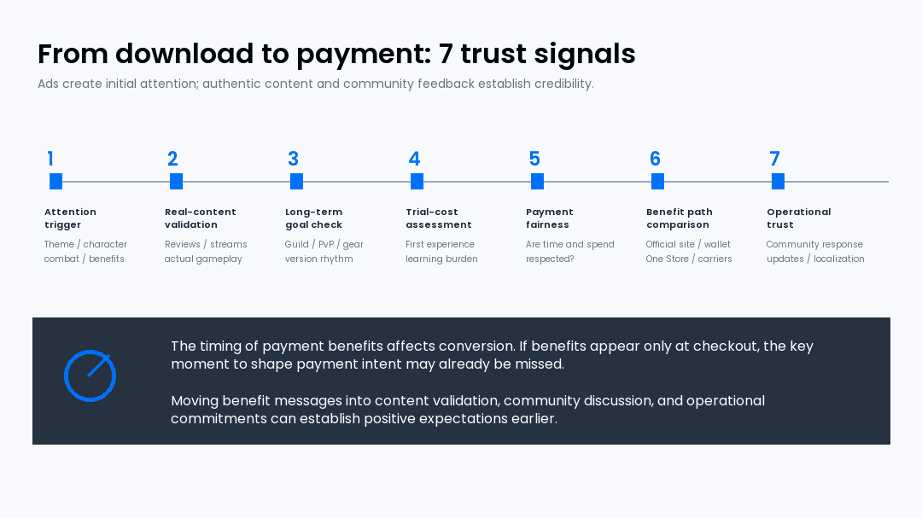
Before Payment, Players Pass Through at Least 7 Trust Signals
Our research shows that Korean players do not move from seeing a game to paying for it through a single ad touchpoint. Instead, they go through a trust-building journey that spans attention, validation, download, gameplay experience, and payment.
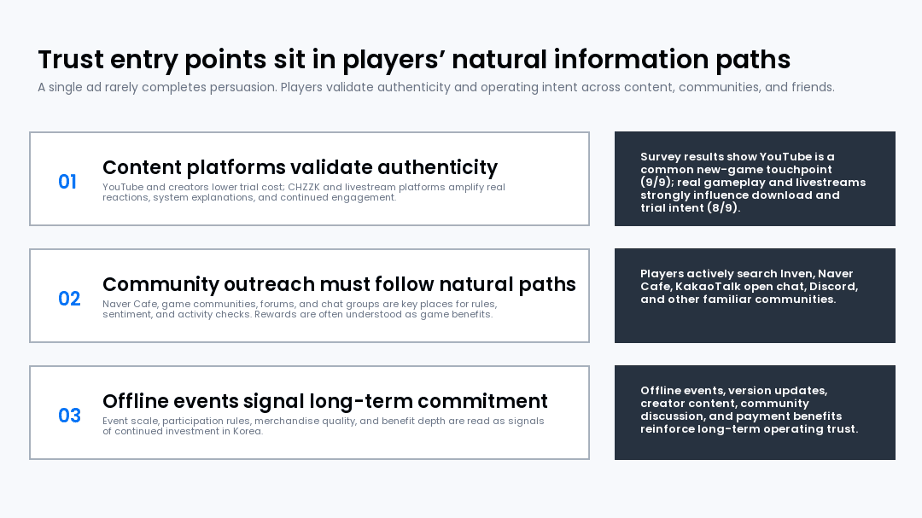
After seeing an ad, players typically continue to cross-check information across multiple channels. YouTube, creator livestreams, Naver Cafe, and Inven are important spaces where players verify real gameplay, observe community sentiment, and assess whether the game is actively operated.
Korean players are not unwilling to pay. Their payment decisions are simply built on more careful trust checks. They look at whether the promotional content matches the actual game experience, whether the game has long-term play value, whether monetization affects fairness, whether their investment in gear, accounts, and social relationships will be respected, and whether the publisher shows a genuine commitment to operating in Korea over the long term.
By the time payment conversion happens, player trust has often already gone through multiple rounds of filtering and validation.
Payment Benefits Are Moving Earlier in the Decision Journey
Traditionally, payment has often been treated as the final step in the transaction journey: once players decide to buy, they choose a way to pay.
In Korea, however, payment benefits themselves can influence whether players are willing to enter the payment journey in the first place. Players compare the real value they receive across official websites, One Store, local e-wallets, telecom carrier discounts, Google Play Points, and cashback or rebate mechanisms.
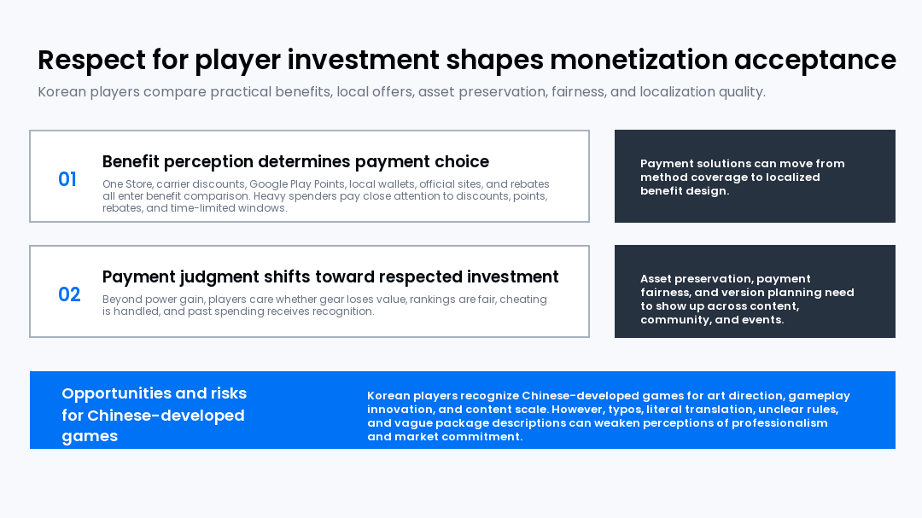
As payment infrastructure becomes more mature, competition between payment paths is shifting from availability and convenience toward clarity of benefits, reasons to switch, and the ability to sustain value over time.
When payment benefits are introduced earlier through content validation, community discussions, and live operations, payment is no longer just the final transaction step. It becomes part of local trust-building.
Clear, stable, and visible payment benefits help players better understand why paying through a specific channel is worthwhile.
Different Genres Have Different Trust Barriers
Different game genres rely on different player motivations, asset structures, fairness expectations, progression loops, and long-term goals. As a result, each genre has its own trust barriers.
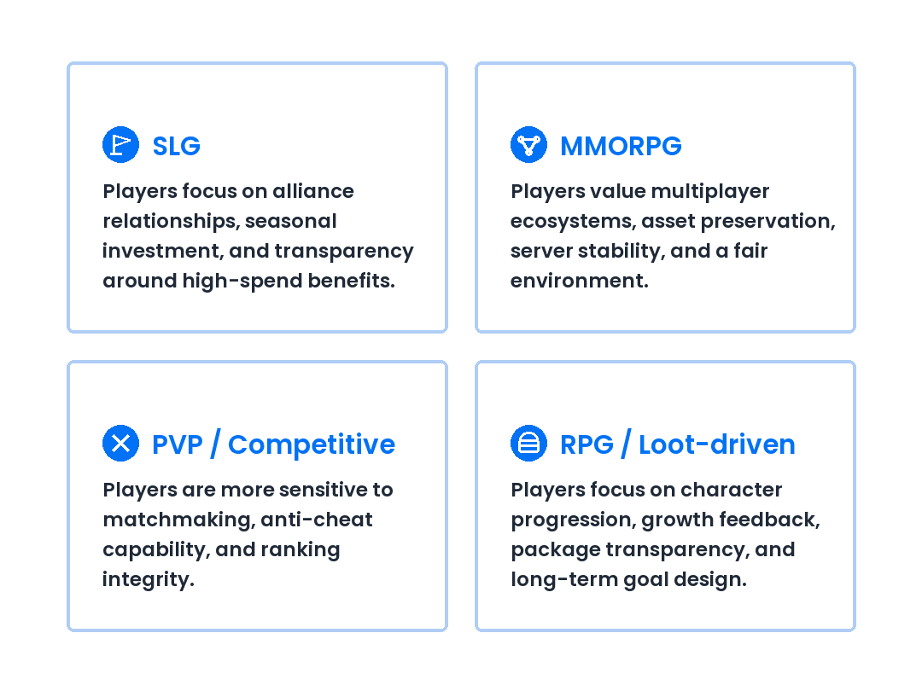
In Korea, localization is moving beyond language adaptation and payment method integration. Players are not only asking whether a game is playable or payable. They also want to know whether their investment will be rewarded, whether monetization will undermine fairness, and whether their accounts, gear, and social relationships will be respected over the long run.
How payment benefits are communicated, how live events are structured, and how users are retained after payment all depend on a deeper understanding of each genre’s gameplay logic and player investment model.
First Payment Is the Beginning of Trust Fulfillment
Korea is not a closed market, but players apply stricter standards when evaluating whether a product can deliver on its promises.
Our research shows that Korean players recognize the strengths of Chinese-developed games in art direction, gameplay innovation, and content scale. At the same time, misleading ads, unclear rules, localization issues, and aggressive monetization pressure can quickly weaken players’ perception of a game’s professionalism and long-term value.
First payment does not mean trust is complete. If the gameplay experience, benefit structure, and operational response continue to meet player expectations over time, paying users are more likely to become long-term users.
Authentic content, community communication, payment benefits, and long-term operations all shape how players evaluate a game’s long-term value.